Big Data & Distributed Systems
Large-Scale Data Engineering & Knowledge Graphs
Distributed Graph Processing, Semantic Web Modeling, and Scalable Analytical Workflows
Technologies & Stack
Apache Spark
RDF / RDFS / OWL
SPARQL
GraphDB
Python
Distributed Storage (DFS)
Project Overview
Developed as the core project for Big Data Analytics (BDA) at UPC, this engineering project addressed the architectural challenges common to large-scale industrial data pipelines—such as data silos, heterogeneous schemas, and uncoordinated processing workflows.
Working in a team of three (with Ramon Andreu and Daniel Lopez), we architected an enterprise-grade distributed data pipeline integrating heterogeneous data sources into unified Knowledge Graphs managed with GraphDB, querying complex relational patterns via SPARQL, and running distributed processing with Apache Spark.
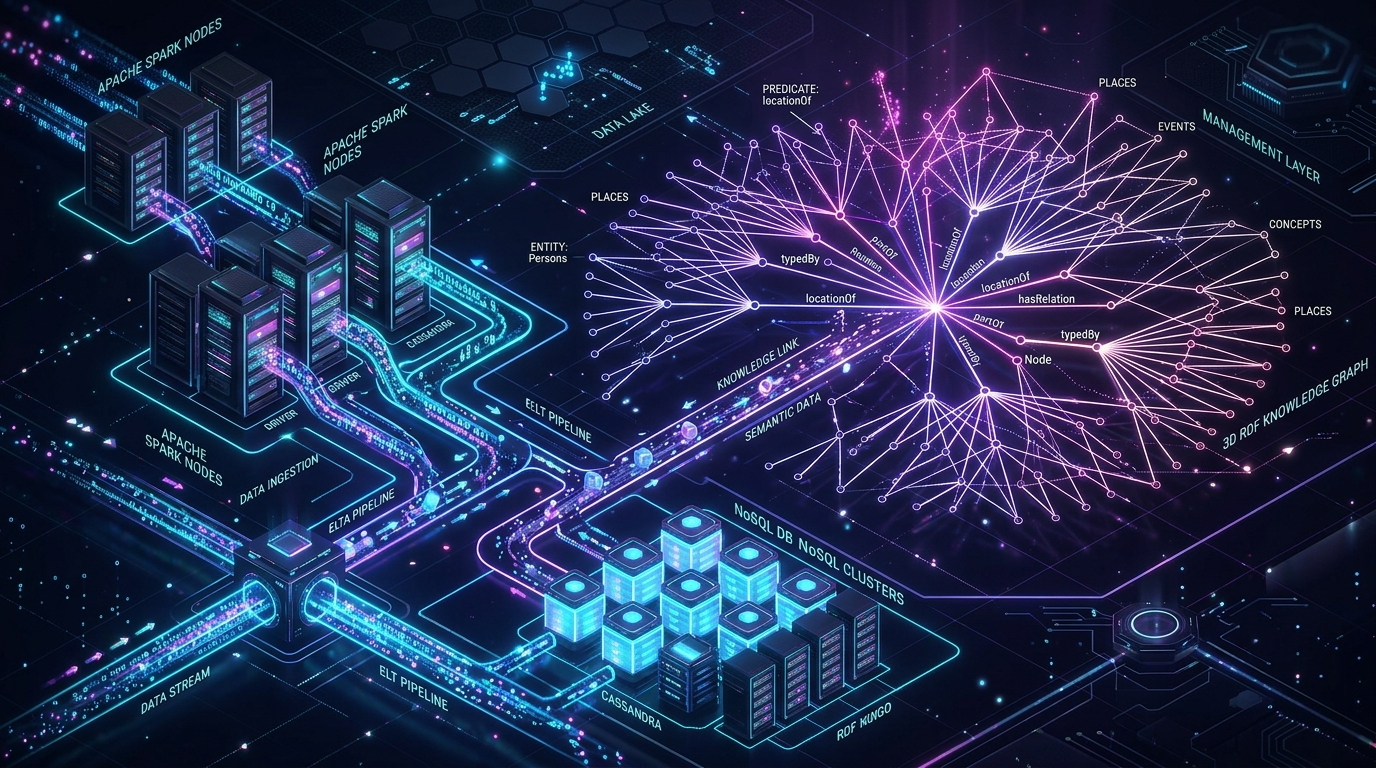
Figure 1: Distributed data lifecycle architecture linking Apache Spark processing nodes, NoSQL Cassandra clusters, and 3D RDF Knowledge Graph triplestores.
System Architecture & Data Lifecycle
- 1. Distributed Ingestion & Processing: Automated ETL pipelines cleaning raw sensor, commercial, and operational records using Apache Spark and distributed workers.
- 2. Semantic Modeling (RDF/S & OWL): Formal ontology design linking domain concepts, hierarchical classifications, and relational constraints using RDFS standards.
- 3. High-Throughput SPARQL: Optimized graph query execution across millions of triples in GraphDB, extracting real-time analytical indicators.
Key Technical Contributions
- Ontological Triplification: Transformed raw tabular and semi-structured datasets into linked RDF triplestores adhering to standard semantic ontologies.
- Analytical Graph Querying: Formulated complex federated SPARQL queries incorporating property paths, aggregation filters, and semantic inference rules.
- Resilient Data Architecture: Designed storage and processing layers preventing unshared local data traps, ensuring reproducible and verifiable analytics across the distributed cluster.