IEEE BigData 2024 Cup — Predicting Chess Puzzle Difficulty
Machine Learning Difficulty Estimation Combining Neural Chess Engines
Technologies & Stack
Python
Scikit-learn
LightGBM / XGBoost
Chess Engines (Stockfish, Leela, Maia)
Feature Engineering
Pandas / NumPy
Project Overview
Participated in the IEEE BigData 2024 Cup competition with team PlatsBruts, competing to accurately predict the human solving difficulty rating (Elo) of tactical chess puzzles from millions of positions.
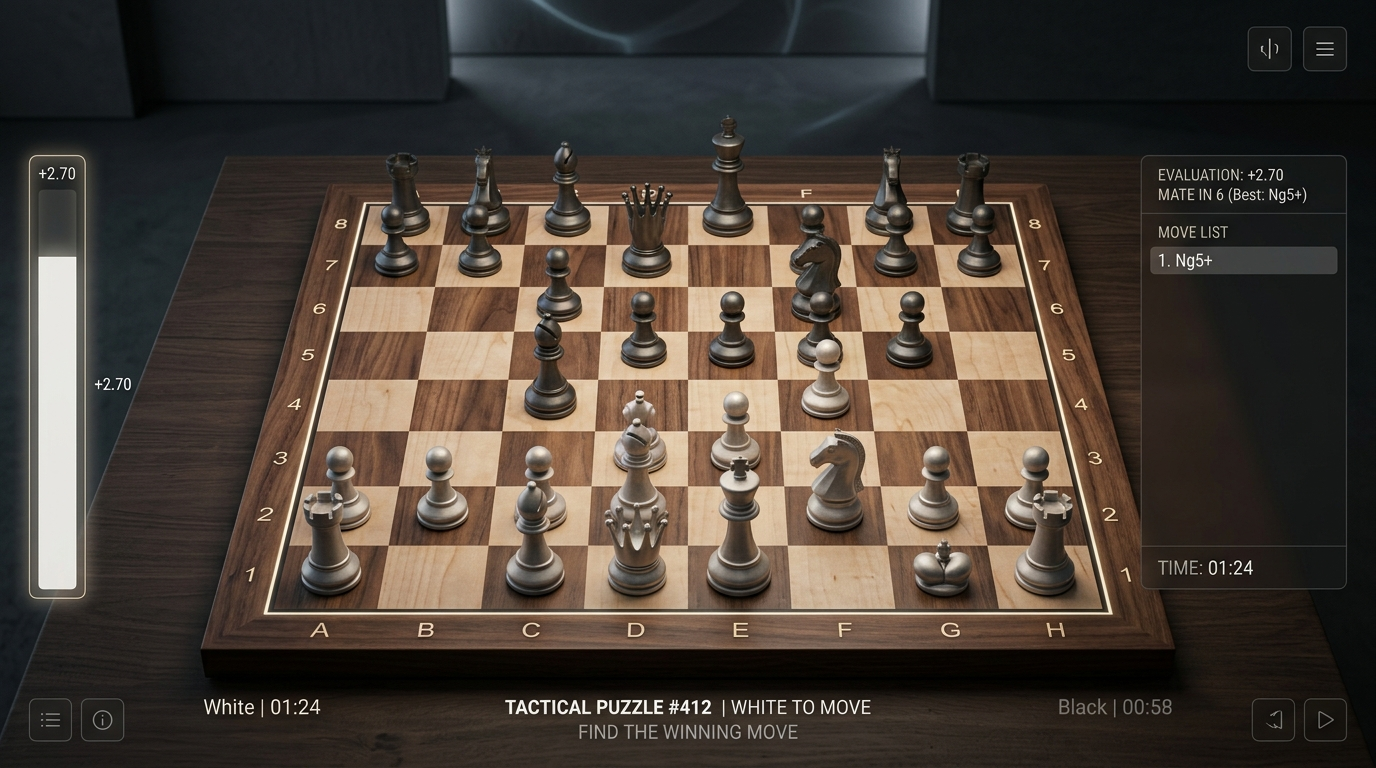
Figure 1: Tactical chess puzzle position evaluation combining deep engine search depth (Stockfish) with human behavioral probability distributions (Maia Chess).
Predicting puzzle difficulty is challenging because traditional chess engines evaluate objective positional advantage rather than human cognitive difficulty. A move that is trivial for an engine to calculate can be virtually invisible to a human master, and vice versa.
Technical Methodology & Feature Engineering
1. Engine Heuristic Features
- Stockfish Search Dynamics: Evaluated positions at varying depths to extract centipawn volatility, move order stability, node count expansion, and evaluation deltas between the best move and second-best alternative.
- Shannon Entropy of Move Distribution: Calculated the entropy over candidate move probabilities; high entropy reflects ambiguous positions with many plausible-looking decoy moves (blunder traps).
2. Human Behavior Modeling with Maia Chess
- Maia Neural Networks: Unlike standard superhuman engines, Maia is trained directly on millions of human games across specific rating tiers (Maia 1100 to Maia 1900) to predict the exact move a human at that rating would make.
- Extracted disagreement rates between superhuman ground truth (Stockfish) and human expectation (Maia) as direct proxies for tactical difficulty and intuitive traps.
3. Gradient Boosted Decision Ensembles
- Trained LightGBM and XGBoost regression models with Bayesian hyperparameter optimization and k-fold cross-validation, optimizing Root Mean Squared Error (RMSE) against verified human rating benchmarks.